
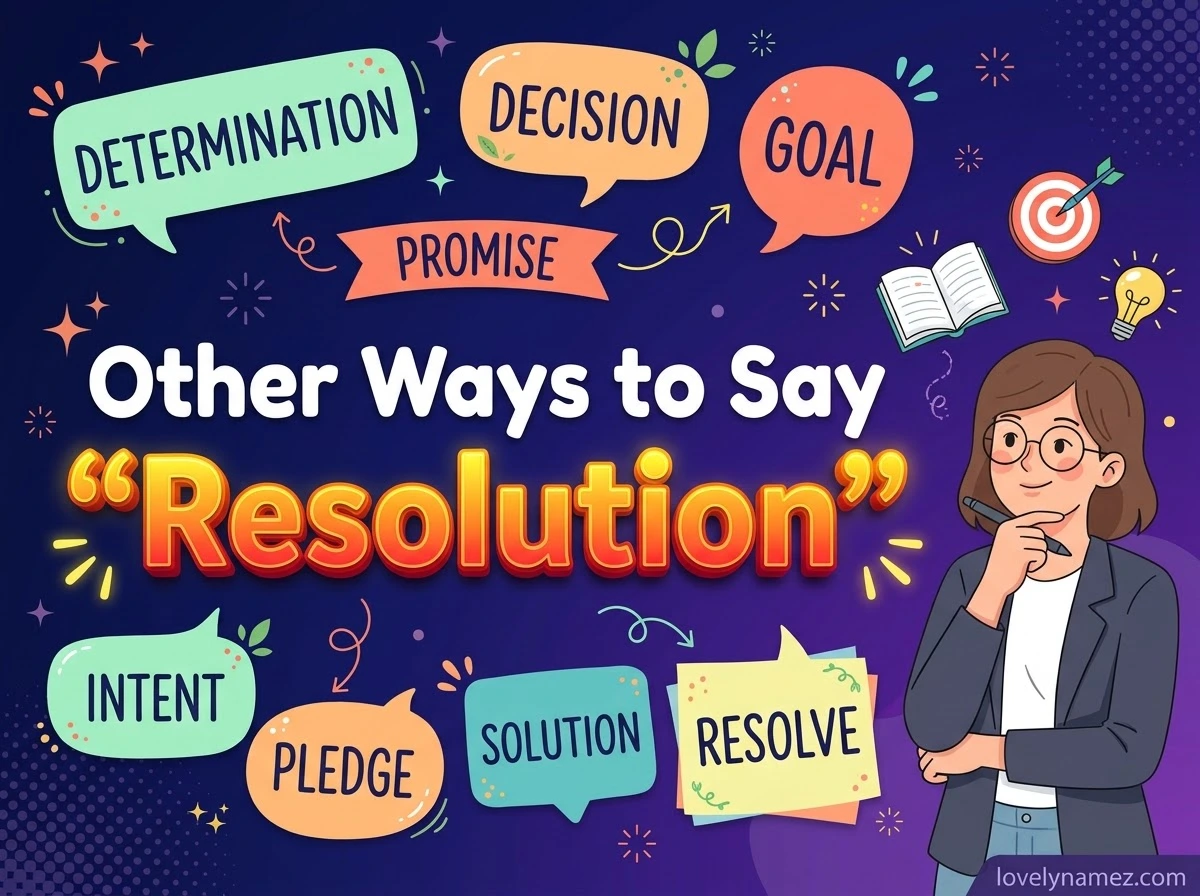
The word “resolution” is commonly used when talking about solving problems, making decisions, setting goals, or finding answers to difficult situations. It can describe the successful outcome of a disagreement, a firm promise to improve something, or an official decision made by a group. Because it has several meanings, choosing the right alternative can make your communication clearer and more natural.
There are many situations where you might want to explore other ways to say resolution. For example, you may be writing a professional email, discussing a customer complaint, describing how a conflict was handled, or talking about personal goals. Using the same word repeatedly can make your writing sound less interesting and sometimes less precise.
The best alternative depends on what you want to communicate. Words such as solution, settlement, and agreement work well when discussing problems or disagreements. Expressions such as determination, commitment, and firm intention are more suitable when discussing personal goals or future plans.
In this guide, we will explore 30 useful alternatives to the word “resolution,” along with their meanings, explanations, practical examples, best uses, and tones. Whether you are an English learner, student, professional, or everyday writer, these expressions will help you communicate with greater confidence.
Quick Answer
If you are looking for other ways to say “resolution,” here are seven useful alternatives:
- Solution: A way to solve a problem or difficult situation.
- Settlement: An agreement that brings a disagreement or dispute to an end.
- Agreement: A shared decision or understanding between two or more parties.
- Conclusion: The final result or decision after considering something.
- Determination: A strong intention to achieve something.
- Commitment: A promise or dedication to follow through with an action.
- Decision: A choice made after considering different possibilities.
Example:
- Original: The team finally reached a resolution to the problem.
- Alternative: The team finally found a solution to the problem.
The most appropriate alternative depends on whether you are referring to solving a problem, ending a disagreement, making a formal decision, or setting a personal goal.
What Does “Resolution” Mean?
The word “resolution” has several meanings depending on the situation in which it is used.
Its most common meaning is the act of solving a problem, disagreement, or difficult situation. When people reach a resolution, they usually find an answer or agree on a way forward.
For example:
- The manager helped the employees reach a resolution to their disagreement.
- We are working toward a resolution of the customer complaint.
Resolution can also refer to a firm decision or promise to do something. This meaning is especially common when people discuss personal goals, New Year’s resolutions, or plans for self-improvement.
For example:
- My New Year’s resolution is to exercise regularly.
- She made a resolution to improve her communication skills.
In formal settings, a resolution can also mean an official decision passed by an organization, committee, or government body.
For example:
- The committee approved a resolution supporting the new policy.
Therefore, understanding the context is important before choosing a replacement. A solution may replace resolution when discussing a problem, while determination may be more appropriate when discussing personal goals.
Is It Professional or Polite to Say “Resolution”?

Yes. “Resolution” is both professional and polite. It is widely used in business communication, customer service, academic writing, legal discussions, and everyday conversations.
In professional environments, the word is particularly useful because it sounds neutral and focuses on finding a positive outcome rather than assigning blame.
For example:
- We appreciate your patience while we work toward a resolution.
- Our priority is to find a fair resolution to this matter.
- The management team is reviewing the issue to reach a suitable resolution.
It is also appropriate in formal documents and meetings.
However, using the same word repeatedly can make your writing sound repetitive. Depending on the context, alternatives such as “solution,” “settlement,” “agreement,” and “conclusion” may communicate your message more naturally.
For personal goals, words such as “commitment,” “determination,” and “intention” can be more specific.
The key is to select an expression that accurately represents your intended meaning while maintaining the appropriate level of formality.
Advantages and Disadvantages of Saying “Resolution”
The word “resolution” is useful in many situations, but it also has certain limitations. Understanding its strengths and weaknesses can help you decide when to use it and when another expression might work better.
Advantages
- Sounds professional and respectful: Resolution is a neutral expression that works well in business emails, meetings, reports, and formal conversations. It allows people to discuss difficult situations without sounding aggressive or emotional.
- Communicates a positive outcome: When used to describe solving a problem, resolution suggests progress toward an answer or agreement. It focuses attention on moving forward rather than remaining stuck on the issue.
- Works in different contexts: The word can describe personal goals, official decisions, conflict management, and problem-solving. This flexibility makes it useful in both professional and everyday communication.
Disadvantages
- Can have multiple meanings: Resolution can refer to a solution, an official decision, or a personal commitment. Without enough context, readers may not immediately understand which meaning is intended.
- May sound formal in casual conversations: In everyday discussions, expressions such as “fix,” “answer,” or “way forward” may sound more natural. Resolution can sometimes make a simple situation seem unnecessarily complicated.
- Can be repetitive: Using resolution several times in the same paragraph or email may reduce readability. Choosing suitable alternatives helps make writing more varied and precise.
Synonyms and Alternatives for “Resolution”
Here is an overview of 30 natural expressions you can use instead of “resolution.” Some are close synonyms, while others are contextual alternatives that work better for particular meanings.
- Solution
- Settlement
- Agreement
- Conclusion
- Determination
- Commitment
- Decision
- Outcome
- Compromise
- Understanding
- Answer
- Remedy
- Fix
- Restitution
- Reconciliation
- Finalization
- Closure
- Plan of action
- Course of action
- Firm intention
- Resolve
- Pledge
- Promise
- Formal decision
- Official declaration
- Consensus
- Accord
- Breakthrough
- Way forward
- Conflict settlement
Other Ways to Say “Resolution”
1. Solution

Meaning: A solution is an answer or method that successfully addresses a problem.
Definition: It refers to something that removes a difficulty, corrects an issue, or makes a situation better.
Detailed Explanation: Solution is one of the closest and most commonly used alternatives to resolution when discussing problems. It is straightforward, widely understood, and suitable for professional as well as casual communication. Unlike resolution, which can also refer to a decision or commitment, solution focuses specifically on fixing something.
Scenario Example: A company is experiencing delays in delivering customer orders. After reviewing the process, the manager introduces a better scheduling system.
Example: “We finally found a solution to the delivery problem.”
Best Use: Use solution when discussing technical difficulties, workplace problems, personal challenges, or situations that require an effective answer.
Tone: Neutral, practical, and professional.
2. Settlement
Meaning: A settlement is an agreement that brings a disagreement or dispute to an end.
Definition: It is an arrangement between two or more parties that resolves a conflict, often through negotiation.
Detailed Explanation: Settlement is particularly useful when discussing legal, financial, workplace, or contractual disputes. It suggests that the people involved have agreed on certain terms to avoid further disagreement. Unlike a general solution, a settlement usually involves multiple parties accepting an arrangement.
Scenario Example: Two businesses disagree over an unpaid invoice. After several discussions, they agree on a payment amount.
Example: “Both companies reached a settlement over the unpaid invoice.”
Best Use: Use settlement in legal matters, financial disagreements, business negotiations, and disputes between individuals or organizations.
Tone: Formal, professional, and diplomatic.
3. Agreement
Meaning: An agreement is a shared understanding or decision accepted by two or more people.
Definition: It is a mutual arrangement in which the involved parties accept the same terms, conditions, or expectations.
Detailed Explanation: Agreement is a useful alternative when a resolution involves cooperation between different people. It emphasizes shared acceptance rather than simply finding an answer. It is especially appropriate when the outcome depends on everyone being satisfied with the proposed terms.
Scenario Example: Two coworkers disagree about how to divide their responsibilities. After discussing their concerns, they decide to share the workload equally.
Example: “We finally reached an agreement about how to divide the responsibilities.”
Best Use: Use agreement in workplace discussions, negotiations, family conversations, contracts, and collaborative projects.
Tone: Polite, neutral, and professional.
4. Conclusion

Meaning: A conclusion is the final decision, judgment, or result reached after considering information.
Definition: It refers to the outcome of a discussion, investigation, or process of reasoning.
Detailed Explanation: Conclusion works when resolution refers to the final stage of a discussion or decision-making process. It does not always mean that a problem has been fixed; instead, it emphasizes the result of examining the situation. This makes it especially useful in academic, analytical, and professional writing.
Scenario Example: A research team reviews several reports before deciding which explanation best fits the available evidence.
Example: “After reviewing all the evidence, the team reached a clear conclusion.”
Best Use: Use conclusion in reports, research papers, meetings, discussions, and analytical writing.
Tone: Formal, thoughtful, and objective.
5. Determination
Meaning: Determination is a strong desire and willingness to achieve a particular goal.
Definition: It describes the mental strength and persistence needed to continue working toward an objective.
Detailed Explanation: Determination is an excellent alternative when resolution refers to a personal decision or New Year’s goal. It emphasizes motivation and persistence rather than the final outcome. Someone with determination is prepared to continue making an effort despite difficulties.
Scenario Example: A student decides to improve their grades after struggling with several subjects during the previous semester.
Example: “Her determination to succeed helped her overcome every academic challenge.”
Best Use: Use determination when discussing personal development, career ambitions, education, fitness, and long-term goals.
Tone: Positive, motivational, and encouraging.
6. Commitment
Meaning: Commitment is a strong promise or dedication to doing something.
Definition: It refers to the willingness to remain responsible for an action, responsibility, or goal.
Detailed Explanation: Commitment is useful when discussing a resolution that involves continued effort. It suggests that someone is serious about following through with a decision rather than simply making a temporary promise. It is particularly effective in professional environments and personal development discussions.
Scenario Example: An employee decides to improve their performance by completing training and meeting deadlines consistently.
Example: “She demonstrated a strong commitment to improving her professional skills.”
Best Use: Use commitment when discussing personal goals, workplace responsibilities, relationships, and long-term plans.
Tone: Professional, sincere, and dependable.
7. Decision

Meaning: A decision is a choice made after considering different options.
Definition: It is the act of selecting a particular course of action or reaching a judgment.
Detailed Explanation: Decision is appropriate when resolution refers to choosing what should happen next. It focuses on the choice itself rather than the process of solving a problem. It is one of the most natural alternatives in everyday conversations and professional communication.
Scenario Example: A manager considers several proposals before selecting the most suitable one for the company.
Example: “The management team made a decision to introduce the new working schedule.”
Best Use: Use decision when discussing choices, plans, policies, business matters, and personal situations.
Tone: Neutral, direct, and professional.
8. Outcome
Meaning: An outcome is the result produced by an action, event, or process.
Definition: It describes what happens at the end of a particular situation or series of events.
Detailed Explanation: Outcome is useful when resolution refers to the result of handling a problem. However, an outcome does not necessarily mean that everyone is satisfied or that the issue has been completely solved. It simply identifies what happened after the situation was addressed.
Scenario Example: A company introduces a new customer support system and reviews its effect on customer satisfaction.
Example: “The outcome of the new complaint-handling process was extremely positive.”
Best Use: Use outcome in business reports, project reviews, research, performance discussions, and everyday explanations.
Tone: Neutral, analytical, and professional.
9. Compromise
Meaning: A compromise is an arrangement in which people make concessions to reach a mutually acceptable result.
Definition: It is a middle-ground agreement reached when different parties have conflicting opinions or demands.
Detailed Explanation: Compromise is particularly useful when a resolution requires both sides to adjust their expectations. It recognizes that neither party may receive everything they originally wanted. Instead, everyone accepts a practical arrangement that allows the situation to move forward.
Scenario Example: Two friends disagree about where to spend their holiday. One prefers the mountains, while the other prefers the beach.
Example: “They reached a compromise by choosing a destination with both mountain and beach activities.”
Best Use: Use compromise in negotiations, family disagreements, workplace conflicts, and relationship discussions.
Tone: Cooperative, diplomatic, and considerate.
10. Understanding
Meaning: An understanding is a shared awareness or informal agreement between people.
Definition: It refers to a mutual recognition of expectations, responsibilities, or acceptable arrangements.
Detailed Explanation: Understanding works when a resolution comes from people listening to each other and agreeing on how to proceed. It can be less formal than a written agreement or legal settlement. This expression is especially suitable for relationships and everyday interpersonal situations.
Scenario Example: Two neighbors disagree about noise during the evening. After discussing the problem, they agree to keep the noise down after a certain time.
Example: “We reached an understanding about keeping the neighborhood peaceful.”
Best Use: Use understanding in personal relationships, informal negotiations, workplace conversations, and friendly discussions.
Tone: Friendly, polite, and cooperative.
11. Answer
Meaning: An answer is a response that provides information or addresses a question or problem.
Definition: It is an explanation, solution, or piece of information that responds to a particular issue.
Detailed Explanation: Answer is a simple alternative when resolution means finding a way to deal with a question or challenge. It is less formal and more conversational than resolution. However, it is not always interchangeable because an answer may explain a problem without actually fixing it.
Scenario Example: A customer contacts technical support because their account is not working correctly. The support agent explains how to restore access.
Example: “The technician finally provided an answer to the account access problem.”
Best Use: Use answer in customer service, educational settings, technical support, discussions, and everyday communication.
Tone: Simple, direct, and conversational.
12. Remedy
Meaning: A remedy is an action or measure used to correct a problem or improve an undesirable situation.
Definition: It refers to a practical or official way of addressing a difficulty, mistake, or harmful condition.
Detailed Explanation: Remedy is particularly appropriate when a problem requires corrective action. It is often used in legal, medical, administrative, and professional contexts. Unlike solution, which is broad, remedy can suggest a specific measure intended to correct something that has gone wrong.
Scenario Example: A company discovers that a product has a manufacturing defect and offers customers a replacement.
Example: “The company introduced a suitable remedy for the defective product.”
Best Use: Use remedy when discussing complaints, mistakes, legal issues, workplace problems, and corrective measures.
Tone: Formal, practical, and authoritative.
13. Fix

Meaning: A fix is a practical action that corrects something that is broken or not working properly.
Definition: It refers to a repair, adjustment, or straightforward solution to a problem.
Detailed Explanation: Fix is a more casual alternative to resolution. It works particularly well when discussing everyday difficulties, technical issues, equipment problems, or mistakes. Although it sounds natural in conversation, it may be too informal for some official reports or sensitive business correspondence.
Scenario Example: An employee notices that the office printer keeps producing blank pages. The IT department adjusts its settings.
Example: “We finally found a fix for the printer problem.”
Best Use: Use fix in casual conversations, technical discussions, workplace chats, and everyday problem-solving situations.
Tone: Casual, direct, and practical.
14. Restitution
Meaning: Restitution is the act of compensating someone for a loss, damage, or wrongdoing.
Definition: It refers to returning something or providing compensation to restore what another person has lost.
Detailed Explanation: Restitution is a specialized alternative that may apply when resolving a dispute involves repairing financial or material harm. It is commonly associated with legal and financial matters. It is not a general synonym for resolution because it specifically focuses on restoring losses or providing compensation.
Scenario Example: A business accidentally damages a customer’s equipment and agrees to cover the repair costs.
Example: “The company provided restitution for the damage caused to the customer’s equipment.”
Best Use: Use restitution in legal discussions, financial disputes, compensation arrangements, and situations involving damaged property.
Tone: Formal, legal, and serious.
15. Reconciliation
Meaning: Reconciliation is the process of restoring a friendly or cooperative relationship after disagreement.
Definition: It refers to bringing people or groups back into harmony after conflict, tension, or separation.
Detailed Explanation: Reconciliation is a meaningful alternative when resolution involves repairing a damaged relationship. It focuses on rebuilding trust and reducing hostility rather than simply ending an argument. It is particularly appropriate in family, friendship, workplace, and community situations.
Scenario Example: Two longtime friends stop speaking after a misunderstanding. After an honest conversation, they apologize and rebuild their friendship.
Example: “Their sincere conversation helped bring about reconciliation.”
Best Use: Use reconciliation when discussing relationships, family disagreements, workplace conflicts, and community disputes.
Tone: Warm, positive, and diplomatic.
16. Finalization

Meaning: Finalization is the process of completing the remaining steps needed to make something official or complete.
Definition: It refers to bringing a plan, agreement, document, or arrangement to its final stage.
Detailed Explanation: Finalization can replace resolution when the focus is on completing an agreed process. It does not necessarily mean solving a conflict or making a new decision. Instead, it emphasizes that the details have been settled and the matter is ready to be completed.
Scenario Example: A company negotiates a partnership agreement and reviews the final terms before signing.
Example: “The finalization of the partnership agreement is expected next week.”
Best Use: Use finalization in business communication, project management, contracts, administrative work, and official documentation.
Tone: Formal, organized, and professional.
17. Closure
Meaning: Closure is a sense of completion or emotional peace after a difficult experience.
Definition: It describes the feeling or process of bringing an unresolved personal or emotional matter to an end.
Detailed Explanation: Closure is especially useful when resolution refers to moving on from a painful or uncertain situation. Unlike solution, it does not always mean that every practical problem has been fixed. Instead, it emphasizes emotional acceptance and the ability to move forward.
Scenario Example: After several months of uncertainty, a person finally has an honest conversation with a former friend.
Example: “That conversation gave her the closure she needed to move forward.”
Best Use: Use closure when discussing relationships, personal struggles, emotional experiences, and difficult life events.
Tone: Reflective, emotional, and reassuring.
18. Plan of Action
Meaning: A plan of action is an organized set of steps designed to address a situation or achieve a particular goal.
Definition: It refers to a practical strategy that explains what needs to be done, how it will happen, and who is responsible.
Detailed Explanation: This expression is useful when a resolution requires more than a simple decision. It emphasizes the practical steps needed to improve a situation. In professional environments, it helps teams understand their responsibilities and work toward a shared objective.
Scenario Example: A sales team notices a decline in customer engagement and decides to introduce new marketing activities.
Example: “The department developed a plan of action to improve customer engagement.”
Best Use: Use plan of action in business meetings, project management, education, organizational planning, and problem-solving discussions.
Tone: Professional, practical, and organized.
19. Course of Action

Meaning: A course of action is a particular approach or sequence of steps chosen to handle a situation.
Definition: It refers to the method or direction someone decides to follow when responding to a challenge.
Detailed Explanation: Course of action is a useful alternative when resolution refers to deciding what should happen next. It emphasizes the selected approach rather than the final result. The expression is common in professional, administrative, and strategic discussions.
Scenario Example: A manager discovers that a project is behind schedule and considers several ways to complete it on time.
Example: “The management team agreed on the best course of action to complete the project.”
Best Use: Use course of action in workplace discussions, planning sessions, business reports, and formal decision-making.
Tone: Formal, strategic, and professional.
20. Firm Intention
Meaning: A firm intention is a clear and serious decision to do something.
Definition: It describes a determined purpose or plan that someone genuinely intends to follow.
Detailed Explanation: Firm intention is appropriate when resolution refers to a personal promise or goal. It emphasizes seriousness and purpose without necessarily suggesting that the person has already taken action. It is a useful expression in professional writing and personal development discussions.
Scenario Example: An employee wants to develop stronger leadership skills and decides to attend training sessions throughout the year.
Example: “She has a firm intention to become a more effective leader.”
Best Use: Use firm intention when discussing personal goals, career plans, professional development, and future commitments.
Tone: Serious, confident, and purposeful.
21. Resolve
Meaning: Resolve is a strong determination to achieve something or deal with a difficult situation.
Definition: As a noun, it describes a person’s firm purpose, courage, and willingness to continue despite challenges.
Detailed Explanation: Resolve is especially suitable when resolution refers to personal determination rather than a problem’s final solution. It emphasizes inner strength and the willingness to take action. It is also more concise and expressive in motivational or reflective writing.
Scenario Example: A business owner faces financial difficulties but continues improving the company instead of giving up.
Example: “His resolve to rebuild the business remained strong despite the setbacks.”
Best Use: Use resolve in motivational writing, personal development, leadership discussions, and situations involving perseverance.
Tone: Strong, confident, and inspiring.
22. Pledge

Meaning: A pledge is a serious promise to do something or support a particular cause.
Definition: It refers to a formal or meaningful commitment that someone publicly or personally agrees to honor.
Detailed Explanation: Pledge works when a resolution involves making a promise about future behavior or responsibilities. It is often used in public announcements, organizational campaigns, and personal commitments. Compared with a general intention, a pledge sounds more deliberate and carries a stronger sense of responsibility.
Scenario Example: A company announces that it will reduce unnecessary packaging to support environmental goals.
Example: “The company made a pledge to reduce its packaging waste.”
Best Use: Use pledge in public commitments, social campaigns, organizational announcements, and personal promises.
Tone: Formal, sincere, and responsible.
23. Promise
Meaning: A promise is a statement that someone will do something or avoid doing something.
Definition: It refers to an assurance or commitment given to another person about future actions.
Detailed Explanation: Promise is a natural alternative when resolution describes a personal decision to change behavior. It is simpler and more conversational than formal expressions such as pledge or commitment. However, it usually involves an assurance to someone, while a resolution can be a private decision.
Scenario Example: Someone decides to spend more quality time with their family after realizing that work has taken up too much of their attention.
Example: “He made a promise to spend more time with his family.”
Best Use: Use promise in everyday conversations, relationships, personal goals, and situations involving trust.
Tone: Warm, sincere, and personal.
24. Formal Decision
Meaning: A formal decision is an official choice made by an authorized person or organization.
Definition: It refers to a decision reached through an established procedure or recognized decision-making process.
Detailed Explanation: Formal decision is particularly useful when resolution refers to an official organizational or institutional outcome. It highlights authority and procedure rather than personal opinion. It can be used when discussing committees, management teams, schools, government departments, and professional organizations.
Scenario Example: A university committee reviews a proposal before approving changes to its examination policy.
Example: “The committee announced a formal decision to revise the examination policy.”
Best Use: Use formal decision in administrative documents, organizational announcements, meetings, and institutional communication.
Tone: Official, structured, and professional.
25. Official Declaration

Meaning: An official declaration is a formal public statement that announces a position, decision, or intention.
Definition: It refers to an authorized announcement made by an individual, institution, or organization.
Detailed Explanation: Official declaration can be used when a resolution takes the form of a publicly announced position. It is particularly relevant to government, organizational, and institutional communication. However, it is not interchangeable with resolution in every situation because a declaration communicates a position rather than necessarily settling a dispute.
Scenario Example: A local council announces its approved policy after several public meetings.
Example: “The council issued an official declaration supporting the new community initiative.”
Best Use: Use official declaration in public announcements, government communication, institutional statements, and formal organizational updates.
Tone: Formal, authoritative, and public-facing.
26. Consensus
Meaning: Consensus is a general agreement reached by a group of people.
Definition: It refers to a shared opinion or decision that most or all members of a group can support.
Detailed Explanation: Consensus is a strong alternative when resolution involves collective decision-making. It suggests that people have discussed their differences and reached a position they can accept. Unlike a simple majority decision, consensus emphasizes shared support rather than just counting votes.
Scenario Example: A project team discusses several possible designs before agreeing on one approach that everyone supports.
Example: “After a detailed discussion, the team reached a consensus on the final design.”
Best Use: Use consensus in team meetings, collaborative projects, community discussions, negotiations, and organizational planning.
Tone: Cooperative, diplomatic, and professional.
27. Accord
Meaning: An accord is a formal or mutual agreement between individuals, organizations, or groups.
Definition: It describes a state of agreement or a negotiated arrangement accepted by the parties involved.
Detailed Explanation: Accord is a more formal alternative to agreement and is commonly used in diplomatic, political, and international contexts. It suggests that different parties have reached an understanding after discussions or negotiations. It is less common in casual conversation but can make formal writing sound precise.
Scenario Example: Two organizations negotiate new terms for working together on a long-term project.
Example: “The organizations reached an accord on their future cooperation.”
Best Use: Use accord in diplomatic communication, formal negotiations, business agreements, and official documents.
Tone: Formal, diplomatic, and sophisticated.
28. Breakthrough

Meaning: A breakthrough is an important development that helps overcome a major difficulty.
Definition: It refers to a significant discovery, achievement, or development that creates progress after a period of difficulty.
Detailed Explanation: Breakthrough is a contextual alternative when resolution involves finding an important new way to solve a difficult problem. It emphasizes progress and discovery rather than simply reaching an agreement. It is often used in science, technology, business, and personal achievement.
Scenario Example: A research team has struggled to understand a technical problem for months before discovering a new method.
Example: “The researchers made a breakthrough that helped them overcome the technical challenge.”
Best Use: Use breakthrough in scientific research, business innovation, technology, negotiations, and challenging personal situations.
Tone: Positive, exciting, and optimistic.
29. Way Forward
Meaning: A way forward is a practical direction or approach for making progress.
Definition: It refers to an agreed or proposed method of moving beyond a problem or difficult situation.
Detailed Explanation: Way forward is a useful expression when a resolution involves deciding what should happen next. It does not necessarily mean that the problem has already been solved. Instead, it focuses on future action and constructive progress. It is especially common in professional communication.
Scenario Example: Two departments disagree about project responsibilities. During a meeting, they identify a practical arrangement that allows the project to continue.
Example: “We need to identify a way forward that works for both departments.”
Best Use: Use way forward in business emails, meetings, negotiations, project discussions, and conflict management.
Tone: Professional, constructive, and diplomatic.
30. Conflict Settlement
Meaning: Conflict settlement is an arrangement or process that brings a disagreement between parties to an end.
Definition: It refers to resolving opposing interests through negotiation, agreed terms, or other accepted arrangements.
Detailed Explanation: Conflict settlement is a specific alternative when resolution refers to ending a disagreement between people or organizations. It emphasizes addressing the conflict and establishing acceptable conditions for the parties involved. It is particularly useful in formal discussions about workplace, political, community, or organizational disputes.
Scenario Example: Two departments have different opinions about budget distribution. Senior management brings them together to negotiate a fair arrangement.
Example: “The organization worked toward a conflict settlement that both departments could accept.”
Best Use: Use conflict settlement in workplace disputes, organizational disagreements, community negotiations, and formal conflict-management discussions.
Tone: Formal, diplomatic, and solution-focused.
Frequently Asked Questions
1. What is the best synonym for resolution?
The best general synonym for resolution is “solution” when discussing a problem. However, “agreement,” “settlement,” and “decision” may be more appropriate when referring to disputes or choices.
2. What is another professional word for resolution?
Professional alternatives include solution, settlement, agreement, conclusion, consensus, and course of action. The best choice depends on the subject and purpose of your communication.
3. How can I say resolution in a formal email?
You can use expressions such as “a suitable solution,” “an agreed outcome,” “a mutually acceptable arrangement,” or “a way forward.”
For example: “We appreciate your cooperation as we work toward a mutually acceptable solution.”
4. What is another word for resolution in problem-solving?
Solution, remedy, fix, answer, and breakthrough are useful alternatives in problem-solving situations. Solution is generally the most natural replacement.
5. What is another word for resolution in conflict management?
Settlement, compromise, reconciliation, agreement, and consensus are useful alternatives when discussing disagreements.
For example: “Both departments reached a compromise after several meetings.”
6. What is another word for New Year’s resolution?
You can use personal goal, commitment, intention, pledge, promise, or determination.
For example: “My personal goal this year is to read more books.”
7. Is resolution the same as determination?
No. Resolution can refer to solving a problem, making an official decision, or setting a personal goal. Determination specifically describes the strength of someone’s intention and willingness to achieve something.
8. Is solution a better word than resolution?
Solution is often better when you want to describe a direct answer to a problem. Resolution is broader and can also refer to agreements, official decisions, and personal commitments.
9. What is a polite way to say we need a resolution?
You can say, “We hope to find a mutually acceptable solution,” or “We would appreciate the opportunity to work toward a positive outcome.”
Both expressions sound respectful and professional.
10. Can I use agreement instead of resolution?
Yes, when the intended meaning involves two or more people accepting the same terms or decision. However, agreement may not work when resolution refers to an individual goal, an official declaration, or a practical solution to a problem.
Conclusion
Choosing the right alternative to “resolution” depends on what you want to express. Use solution for solving problems, settlement for ending disputes, agreement for shared decisions, and determination or commitment for personal goals. In professional communication, expressions such as consensus, course of action, and way forward can make your message sound clear and constructive. Remember that not every alternative has exactly the same meaning. Consider your audience, situation, and intended message before selecting an expression.
